Quick Facts
| Location |
Straits of Mackinac, between Michigan’s Upper and Lower Peninsulas |
| Pronunciation |
Mackinac is pronounced "MACK-in-aw" - the final "c" is silent |
| Known For |
Horse-drawn carriages, Fort Mackinac, Arch Rock, historic architecture, and fudge |
| Best Time to Visit |
Late spring through early fall, depending on whether you prefer lilacs, summer activity, or fall color |
| Recommended Stay |
1–2 days for most first-time visitors |
| Best For |
History, Great Lakes scenery, leisurely sightseeing, biking, and local traditions |
| Getting Around |
Walking, bicycle, horse-drawn carriage, or horseback |
Why Visit Mackinac Island?
Horse hooves on pavement.
Bicycle bells on Main Street.
Lake Huron stretching beyond limestone bluffs.
Arriving on Mackinac Island feels like crossing more than a few miles of water. Most visitors come by ferry from Mackinaw City or St. Ignace, Michigan, and once ashore, the familiar rhythm of automobile traffic is replaced by horses, bicycles and pedestrians.
That difference gets much of the attention, but Mackinac Island has far more to its story.
Its position in the Straits of Mackinac made the area significant to Indigenous peoples long before European arrival and later placed it at the center of the fur trade and struggles for control of the Great Lakes. Ancient waters helped shape its limestone landscape, while Victorian-era travelers later transformed the island into a celebrated summer destination.
Today, more than 80% of Mackinac Island is protected within Mackinac Island State Park.
The result is an unusual combination of natural landscape, living traditions and layers of history – all contained on an island where simply getting from one place to another is part of the experience.
What Makes Mackinac Island So Unique?
Start with its geography.
Mackinac Island sits in the Straits of Mackinac, where Lakes Michigan and Huron meet. Its location gave the island strategic and cultural importance far beyond its relatively small size.
The landscape beneath that history has an even older story.
Mackinac’s distinctive formations are largely composed of limestone, including brecciated limestone made from fragments of rock naturally cemented together. Ancient Great Lakes water levels and erosion helped shape many of the cliffs, caves, stacks and arches visitors see today.
Then there’s the island’s transportation culture.
The Village of Mackinac Island prohibited “horseless carriages” in 1898 after early automobiles frightened horses. Mackinac Island State Park followed with its own restriction in 1901.
Limited authorized motor vehicles operate today, but horses, bicycles and pedestrians still dominate everyday transportation.
That changes more than traffic.
It changes what Mackinac sounds like.
📍 Did You Know?
-
Mackinac was once a national park. Congress established Mackinac National Park in 1875, making it the nation’s second national park after Yellowstone. In 1895, the land was transferred to Michigan and became Mackinac Island State Park – Michigan’s first state park.
-
An 8.2-mile state highway circles the island. M-185 follows Mackinac Island’s shoreline, but unlike most highways, its traffic consists primarily of bicyclists, pedestrians and horse-drawn vehicles.
-
There are more than 70 miles of roads and trails. Beyond the waterfront, hiking, biking, and carriage routes lead through forests, over bluffs and past geological and historic sites throughout Mackinac Island State Park.
-
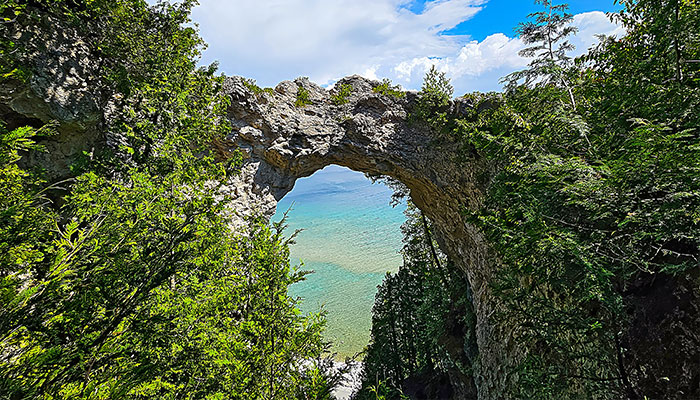
Arch Rock rises 146 feet above Lake Huron. The limestone arch spans roughly 50 feet at its widest point, framing the lake through one of Mackinac’s most recognizable natural formations.
Together, these details reveal an island where preservation hasn’t been limited to individual landmarks – it has helped shape the entire experience.
Things to Do on Mackinac Island
Mackinac is best understood through experiences that reveal different sides of the island – its landscapes, history, traditions and relationship with the Great Lakes.
Explore by Horse-Drawn Carriage
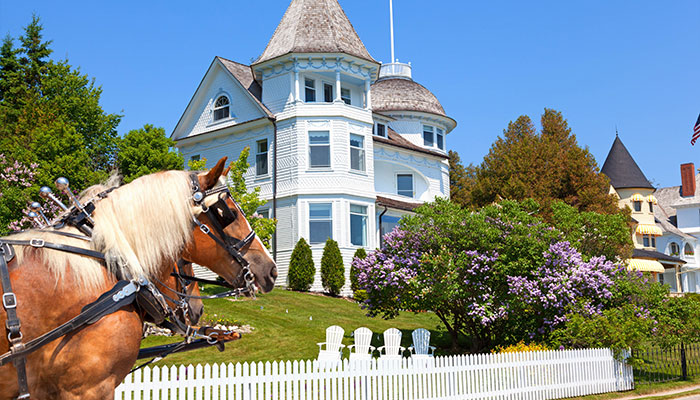
On Mackinac, horses aren’t brought out simply for visitors.
They’re part of daily transportation.
Carriages move through downtown and into the island’s interior, while the steady clip-clop of hooves becomes part of the soundtrack of a visit.
For first-time travelers, a narrated carriage tour can also provide a comfortable introduction to Mackinac’s major landmarks and history.
💡 Travel Tip: For travelers who prefer not to walk or cycle long distances, carriage transportation provides another way to experience more of the island.
Look Through Arch Rock
Arch Rock frames the blue water of Lake Huron through an opening in a limestone bluff.
Its appearance is striking, but understanding how it formed makes the view more interesting. The arch is part of a landscape shaped by ancient water levels and erosion long before forts, hotels and summer cottages appeared.
It’s a reminder that Mackinac’s story begins with geology, not people.
Walk Through History at Fort Mackinac
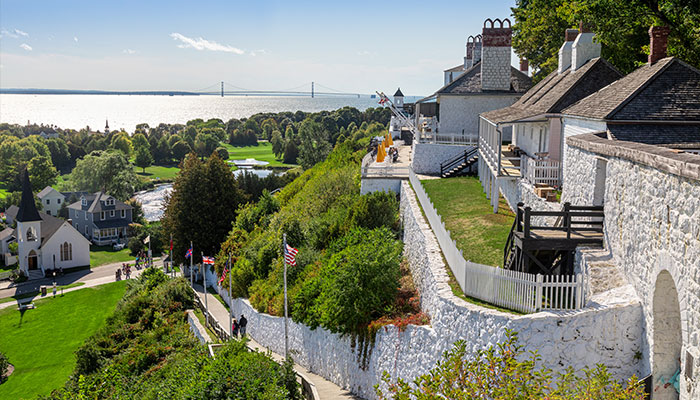
Fort Mackinac occupies a commanding position above the harbor.
During the American Revolution, the British relocated their garrison and community from Michilimackinac on the mainland to Mackinac Island between 1779 and 1781, beginning construction of the fort in 1780.
The United States took control in 1796. British forces captured the fort again in July 1812 during the War of 1812, and American troops unsuccessfully attempted to retake the island in 1814 before Mackinac returned to U.S. control following the war.
Today, original buildings, exhibits and historical interpretation tell the stories of the soldiers and families who lived there.
Look from the fort toward the Straits and its strategic location becomes immediately clear.
Bicycle Around the Island
Cycling M-185 offers one of the most distinctive ways to experience Mackinac.
The 8.2-mile highway follows the shoreline, with frequent views of Lake Huron and opportunities to stop at natural and historic sites.
Without ordinary automobile traffic, the ride has a character unlike other state highways.
The island’s interior roads and trails offer additional options, although they can involve more climbing than the shoreline route.
💡 Travel Tip: Don’t treat the loop like a race. Leave time for stops along the shoreline and at points of interest.
Explore Mackinac Island State Park
Downtown may receive much of the attention, but the majority of Mackinac Island is state parkland.
More than 70 miles of roads and trails extend into the island’s interior, passing forests, bluffs, geological formations and historical sites.
This is where visitors who know Mackinac primarily for fudge and carriages can discover a quieter side of the island.
See Grand Hotel
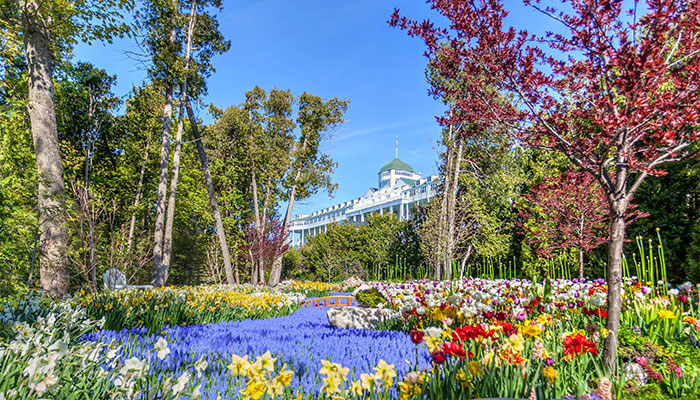
Grand Hotel opened in 1887 as Mackinac was becoming an important summer destination for travelers arriving by lake steamer and rail.
Its 660-foot Front Porch became one of the hotel’s defining architectural features and remains one of the island’s most recognizable sights.
The hotel represents a different chapter of Mackinac history. Military strategy and the fur trade shaped the island’s earlier development. Tourism helped create the Mackinac travelers recognize today.
💡 Travel Tip: Non-hotel guests should check Grand Hotel’s current visitor policies before planning a visit, as access requirements and fees can change.
Wander Downtown and the Waterfront
Main Street is where many of Mackinac’s personalities overlap.
Ferries arrive at the harbor. Carriages pass historic storefronts. Bicycles line the streets. Confectioners work fudge across marble slabs behind shop windows.
It’s worth leaving some time unscheduled here.
Rather than treating downtown as another attraction to check off a list, watch how the island functions around you.
What Food Is Bar Harbor Known For?
Mackinac Island Fudge
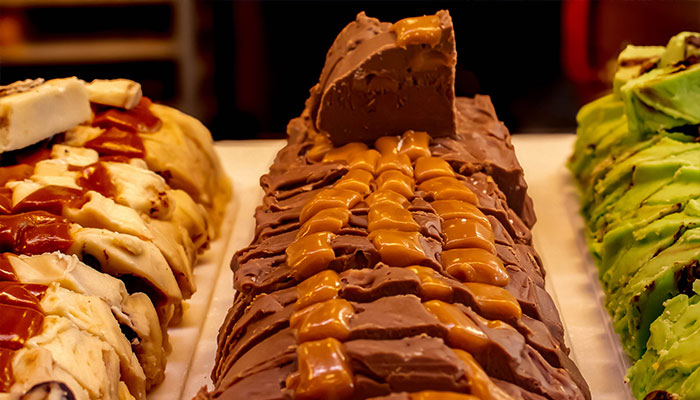
You may smell Mackinac’s most famous food before you taste it.
Commercial fudge-making became part of the island’s tourism story in the late 19th century. Murdick’s Candy Kitchen opened in 1887, and confectioners prepared fudge on large marble slabs that helped cool the mixture.
Visitors could watch the process.
That turned candy-making into part confectionery, part performance – a tradition that continues in island fudge shops today.
Over time, fudge became so closely associated with Mackinac tourism that visitors acquired a playful nickname: “fudgies.”
Watching warm fudge being worked across marble while the scent of chocolate and sugar fills the shop connects today’s visitors with a tradition more than a century old.
Beyond Main Street: More of Mackinac to Discover
Some of Mackinac’s most important stories are found away from its busiest commercial streets.
Follow Mackinac's Native American Cultural History Trail
Mackinac’s human story began long before British forts, American soldiers or Victorian summer travelers arrived.
The Straits of Mackinac have been home to Indigenous peoples for centuries, with Anishinaabek communities – including Odawa, Ojibway and Potawatomi – maintaining deep connections to the region. Mackinac Island itself has long held cultural significance, including as a burial place for Anishinaabek ancestors.
One way to explore this history is along the Native American Cultural History Trail.
Six interpretive stops along M-185 share stories spanning Mackinac’s earliest settlement through the present day.
Visitors can explore the story further at the Biddle House – Mackinac Island Native American Museum, where exhibits focus on the continuing history of the Anishnaabek and the profound changes their communities experienced during the 19th century.
Together, these places add an essential perspective to Mackinac’s history – one that begins long before the forts and fur trade many visitors first associate with the island.
Explore the Island's Natural History Trails
Mackinac’s protected interior also offers opportunities to learn about its forests, plants and geology.
The Mackinac Island Botanical Trail follows the Arch Rock Bicycle Trail, while the British Landing Nature Trail interprets the island’s natural heritage. The Hardwood Nature Trail explores northern hardwood forests and changing ecosystems.
These quieter routes show just how much of Mackinac exists beyond the waterfront.
When Is the Best Time to Visit Mackinac Island?
Mackinac Island’s primary visitor season runs from May through October, but the experience changes considerably throughout those months.
The best time depends on what you want to see.
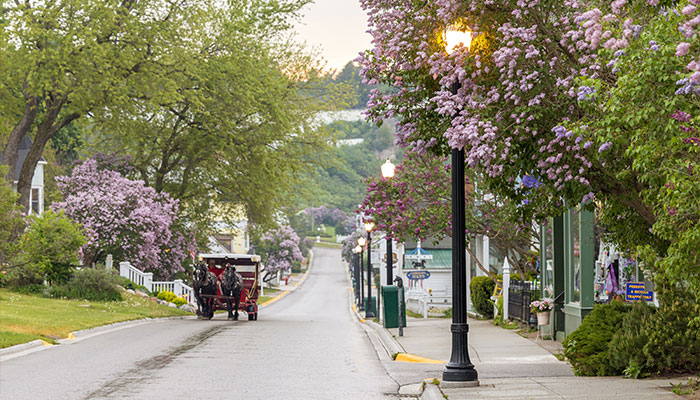
Late Spring – Lilacs and a New Season
May brings the return of seasonal activity, with the island generally becoming busier as Memorial Day approaches.
By late spring and early summer, Mackinac’s famous lilacs add color and fragrance around the island.
Lilacs aren’t native to Mackinac, and exactly who introduced them remains uncertain. What is documented is that Henry David Thoreau recorded seeing lilacs during his 1861 visit – the earliest known written documentation of them on the island.
Today, they’re celebrated during the annual Mackinac Island Lilac Festival in June.
Summer – High Season
Summer brings the widest range of visitor services.
Hotels, restaurants, attractions and carriage tours are operating, and long daylight hours provide plenty of time for sightseeing, cycling and exploring the state park.
It’s also the island’s busiest season.
Independent travelers should consider arranging ferry transportation, lodging and popular activities in advance.
Fall – Color and a Changing Pace
As temperatures cool, Mackinac’s forests begin changing color and the primary visitor season gradually winds down.
September and October can be rewarding for travelers interested in walking, cycling and autumn scenery.
However, seasonal businesses begin reducing operations as fall progresses, and horses start leaving the island for winter pasture.
For late-season travel, checking current operating dates is important.
Winter – A Different Side of the Island
Mackinac remains inhabited year-round, but winter travel is very different from a typical summer visit.
Many seasonal businesses close, transportation becomes more limited and ferry operations can be affected by ice conditions.
For most first-time visitors, late spring through early fall offers the easiest introduction to the island.
Frequently Asked Questions About Mackinac Island
Is Mackinac Island worth visiting?
Yes! For travelers interested in Great Lakes scenery, American history and destinations with a strong sense of place, Mackinac offers an unusual combination of historic sites, protected parkland and distinctive local traditions.
How Many Days Should You Spend on Mackinac Island?
For most first-time visitors, one full day allows time for several major highlights, while two days provides a more relaxed pace and additional time to explore beyond downtown.
When Is the Best Time to Visit Mackinac Island?
Late spring through early fall works well for most visitors. June is associated with the island’s lilacs, summer provides the most comprehensive range of visitor services, and early fall offers seasonal color as the island gradually becomes quieter.
Can you take a car to Mackinac Island?
Most visitors cannot bring automobiles onto Mackinac Island. Travelers leave their vehicles on the mainland and take a ferry from Mackinaw City or St. Ignace, although qualifying mobility devices are permitted for visitors with accessibility needs.
Is Mackinac Island walkable?
Downtown is very walkable, and several attractions can be reached on foot. However, Mackinac includes hills and an extensive network of roads and trails. Horse-drawn carriage transportation provides an alternative for travelers who prefer not to cover longer distances on foot.
Can you visit without riding a bicycle?
Absolutely. Cycling is popular but not necessary. Walking and horse-drawn carriage transportation make it possible to experience Mackinac at different activity levels.
Is Mackinac Island RV friendly?
Think of Mackinac as an excursion rather than an RV camping destination. RVs remain on the mainland while visitors travel to the island by ferry. That makes Mackinac well suited to RVers staying in the surrounding region who want to spend a day exploring without moving their rig.
Why Mackinac Island Stays With You
Perhaps what makes Mackinac memorable is that its history doesn’t sit quietly behind glass.
You hear horses moving through town. You look from a fort across the waterway nations once fought to control. You encounter limestone shaped by ancient waters, Indigenous stories that long predate European arrival and confectioners continuing a tradition born during Mackinac’s rise as a summer destination.
Then there are the smaller moments.
The ferry pulling away from the mainland.
Lake Huron appearing through Arch Rock.
A bicycle rolling beside the shoreline.
The scent of fudge drifting through an open doorway.
Mackinac Island isn’t memorable because it recreates another era.
It’s memorable because its landscape, history and traditions still influence how the island is experienced today.
Explore Mackinac Island with Fantasy RV Tours
Mackinac Island is one memorable destination on Fantasy RV Tours’ 27-Day Great Lakes of North America guided RV tour – an adventure that explores all five Great Lakes and some of the region’s most fascinating places.
With Fantasy, the campgrounds, routes, logistics and planning are taken care of for you. Experienced Tour Leaders help guide the experience, so you can focus on discovering places like Mackinac Island rather than coordinating every detail yourself.
Experiencing Mackinac within a larger Great Lakes journey also adds context to its story. The waterways surrounding the island influenced its Indigenous history, fur trade, military importance and development as a summer destination.
Here, you don’t simply see the Great Lakes.
You begin to understand how they shaped the places around them.
About Fantasy Destination Guides
Fantasy Destination Guides are published by the Fantasy RV Tours team to help travelers better get to know the destinations we visit. Drawing on decades of guided RV travel experience, each guide combines practical planning advice, local history, and destination highlights to help you get more from every journey.